Microbusiness Applications · Quotes, jobs & staged payments
Hooks Building Services
Plan and track staged customer receipts against project costs.
Built for a one-person building microbusiness. Native invoice generation/numbering and a payment gateway are not built; they are documented gaps for a future enhancement. AI scope drafting runs as a deterministic draft; a provider-powered rewrite is not configured. Private workbooks and prices are not shown.
- Quotes
- Jobs
- Calendar
- Cash
- DepositJob startReceived
- Stage 2Start + 4 weeksDue
- Stage 3Start + 8 weeksScheduled
- CompletionOn handoverScheduled
Cash view
- · Cost snapshot
- · Receipts vs costs
- · Forecast
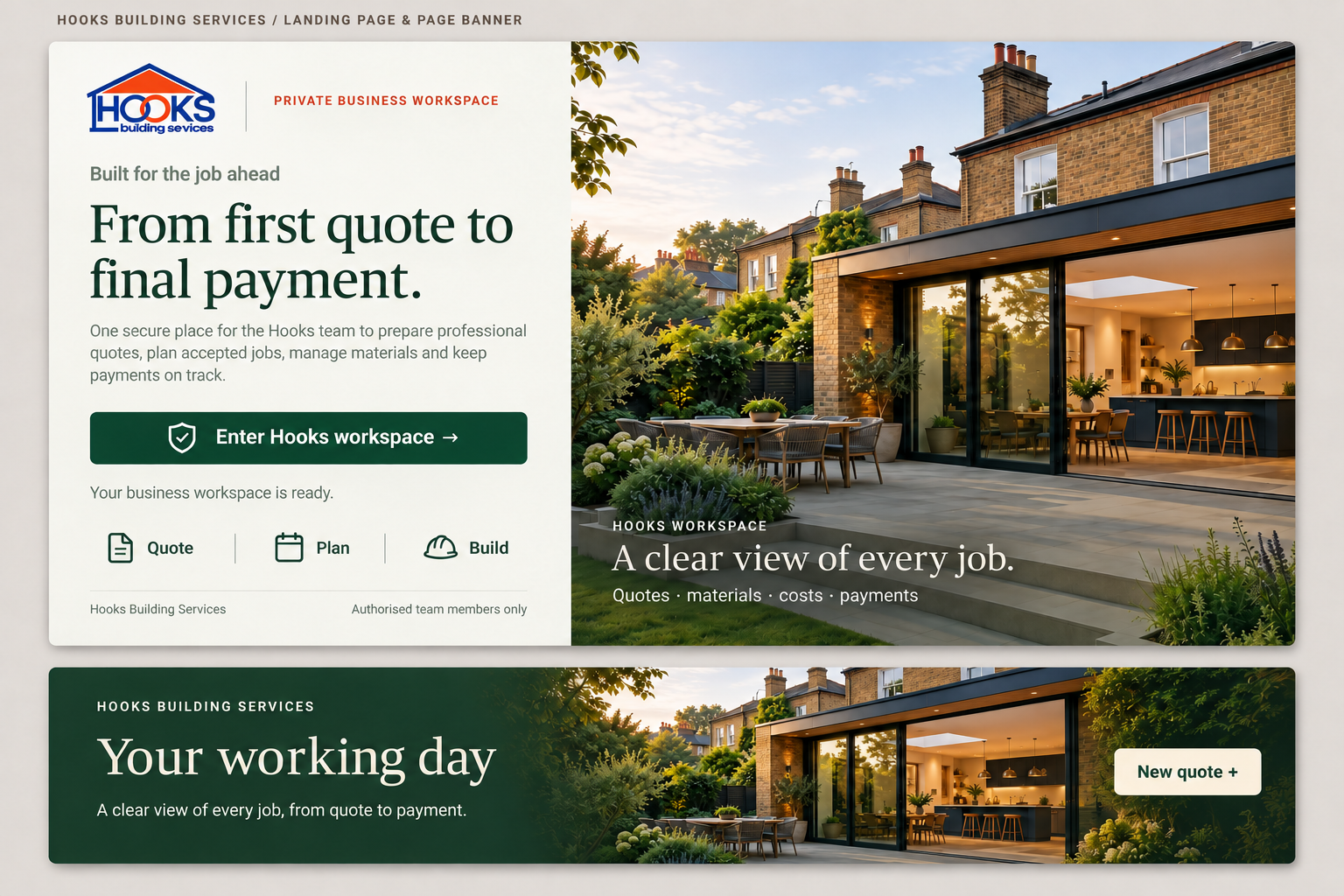
Original branded landing experience
Built for a one-person microbusiness, in its own brand
01The problem
- Building work means buying materials and paying labour weeks before the customer's money arrives.
- Quotes lived in workbooks, disconnected from the jobs they became and the costs they carried.
- Without agreed payment milestones, a profitable project could still leave the business short of cash.
02The application
Professional quotations, accepted jobs, scheduled/staged customer payments, manual receipts and cost tracking; a full native invoicing capability is a future enhancement. Accepted quotes create jobs with materials and labour cost snapshots and an estimated margin; staged payments are auto-dated from the job start and shown on a calendar.
The strategic outcome · cash flow
Plan and track staged customer receipts against project costs
A profitable job is not the same as cash in the bank. As reported by the owner, this app helped the businesses manage the gap between spending on materials/labour and receiving customer payments, reducing reliance on costly ad-hoc bridging borrowing.
Cash conversion journey
Conceptual illustration · not a screenshot1. Materials bought: Cash leaves for materials and labour as the job starts.
Cash-flow story
Illustrative width of the "cash gap", not a measurement.
- Deposit and stage payments agreed on acceptance
- Milestones dated and visible on a calendar
- Receipts tracked against project costs
- Less need for costly ad-hoc bridging
Potential business benefits and measures
Time to invoice
Potential measure · no outcome claimed
Days between materials bought and cash received
Potential measure · no outcome claimed
Payment milestone compliance
Potential measure · no outcome claimed
Reliance on emergency borrowing
Potential measure · no outcome claimed
03Key capabilities
- Branded quotes · PDF & email
- Quote accepted → job created
- Materials & labour cost snapshots
- Estimated job margin
- Staged payments (deposit, 4 weeks, 8 weeks, completion)
- Payment calendar
- Manual receipts & expense ledger
- Forecasts & cash reports
- Quote conversion tracking
- Supplier catalogue & work map
- Native invoicing · planned
Quote to staged payment (illustrative)
Quote
Branded quote sent as PDF by email.
From problem to product
- Accepted quote creates the job
- Staged payments on a calendar
- Receipts and costs side by side
04How I approached the build
- 01
Start with the workbook
Understood how the business already priced work and paid suppliers.
- 02
Structure the quote
Branded, reusable quote lines sent by PDF and email.
- 03
Tie cash to the job
Accepted quotes become jobs with cost snapshots and staged payment milestones.
- 04
Watch the cash
Receipts, expenses, forecasts and cash reports in one place.
05Value for the user
Payment milestones agreed up front and dated from job start
Project costs visible against expected receipts
Earlier sight of cash-flow pressure, easing reliance on bridging borrowing
Qualitative design intent. No performance figures are claimed.