In fact, some of that activity may be evidence that something elsewhere in the business isn't working.
A customer calls because an order hasn't arrived. They email two days later because nobody has updated them. They call again because the promised resolution hasn't happened.
Three contacts. One underlying problem.
And every interaction adds cost, consumes capacity and increases customer frustration.
This is failure demand — work created because something wasn't done correctly, clearly or completely in the first place.
I've seen how easily organisations become focused on handling this demand rather than understanding why it exists.
We measure calls answered, emails processed, cases resolved and average handling time. Those measures have their place, but they don't necessarily tell us whether we're making the customer experience better.
An efficient contact centre can still be supporting an inefficient business.
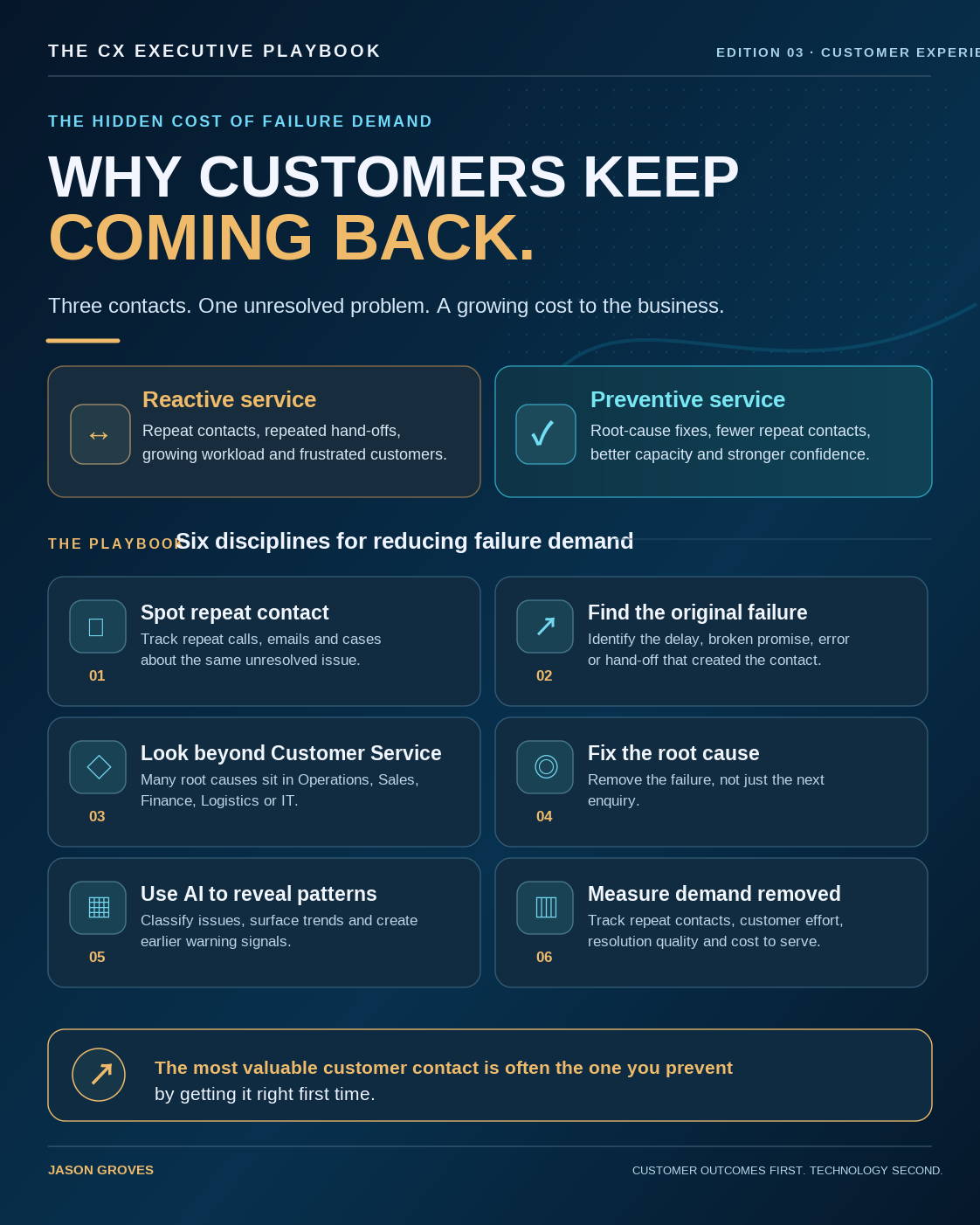
For me, addressing failure demand requires six disciplines:
- Identify repeat contact. Understand how often customers come back about the same unresolved issue.
- Find the original failure. Was it an inaccurate delivery promise, unclear communication, a system problem or an unnecessarily complicated process?
- Look beyond Customer Service. Many customer contacts originate in decisions and processes owned by Sales, Finance, Operations, Logistics or IT.
- Fix the root cause. Removing the underlying failure delivers more lasting value than simply processing the next enquiry faster.
- Use AI to reveal patterns. Classification, trend analysis and early-warning signals can help identify recurring problems that traditional reporting might miss.
- Measure demand removed. Track repeat contacts, customer effort, resolution quality and cost to serve alongside traditional productivity measures.
The commercial implications are significant.
Every avoidable contact consumes time and resource. But the greater cost can be the customer who loses confidence, reduces their spending or takes their business elsewhere.
That is why Customer Service should not simply be measured on how efficiently it handles demand.
It should be empowered to help the wider organisation eliminate the demand that should never have existed.
The most valuable customer contact is often the one you prevent by getting things right first time.
What proportion of your organisation's customer contacts could be avoided by fixing the underlying process?
#CustomerExperience #CustomerService #OperationalExcellence #FailureDemand #DigitalTransformation #ArtificialIntelligence #CXExecutivePlaybook
Key ideas
- 01 Identify repeat contact
- 02 Find the original failure
- 03 Look beyond Customer Service
- 04 Fix the root cause
- 05 Use AI to reveal patterns
- 06 Measure demand removed
Playbook edition · a thought-leadership perspective, not statistical research.